Parking lot cleaning costs involve more than the price of a machine or the amount spent on energy. Maintenance, labor, downtime, and the area cleaned all affect the final bill. Electric and fuel-powered sweepers have different cost profiles, so a useful comparison measures their full operating routines against the same cleaning requirements.
Compare the Total Cost of a Working Shift
Begin with the costs that occur each time the machine runs. For a fuel-powered sweeper, record fuel consumed, lubricant use, and routine servicing linked to engine operation. For an electric unit, record electricity used to recharge the battery and include charging losses where these can be measured. Compare similar work periods and include time required for setup, disposal, and refilling.
Do not treat energy cost as the whole result. Two machines can have different purchase prices, maintenance needs, operating speeds, and staffing requirements. A lower energy bill matters most when the machine also completes the required route to the expected standard.
Calculate Energy Cost per Hour
For a fuel machine, multiply actual fuel consumption per hour by the local price per unit of fuel. For an electric sweeper, multiply measured charging electricity in kilowatt-hours by the applicable electricity tariff. Site bills matter because electricity rates, demand charges, and fuel prices vary by location and contract.
A simple comparison is:
Fuel cost per hour = fuel used per hour × fuel price.
Electricity cost per hour = charging energy used per shift ÷ operating hours × electricity price per kWh.
Battery capacity alone does not show the exact electricity consumed during a shift. Charger efficiency, route conditions, workload, and battery state affect the power drawn from the outlet. Record the electricity used to recharge the machine rather than assuming the battery’s rated capacity equals each shift’s consumption.
Include Maintenance and Downtime
Fuel-powered equipment usually has engine-related service items such as oil changes, filters, belts, and fuel-system checks. Electric equipment removes many engine-related tasks, but it still needs inspections, brush or suction-component replacement, tire and wheel checks, battery care, and repairs. Actual costs depend on design, workload, climate, parts prices, and service access.
Downtime also has a cost. When a sweeper is unavailable, staff might need to clean manually, hire a contractor, or postpone the route. Review maintenance logs and supplier service terms to estimate likely downtime, spare-parts lead times, and warranty coverage. A machine with a low energy cost can become expensive if repairs interrupt cleaning at peak times.
Compare Cost With Accepted Cleaning Output
Hourly cost alone can mislead when machines work at different speeds. Record the area cleaned to the required standard, then calculate total cost per accepted square meter:
Cost per accepted m² = total operating cost ÷ accepted area cleaned.
Include labor, energy, routine maintenance, repairs, consumables, and any manual touch-up. Use the same inspection standard for both machines. A sweeper that moves quickly but leaves debris at corners or around parked vehicles could require extra passes, changing the cost comparison.
This measure also helps assess power sweepers for parking lots across different property sizes. Large open lots, multilevel structures, and narrow parking aisles create different turning, access, and route requirements. Compare machines on a representative site rather than relying solely on brochure coverage rates.
Apply the Comparison to Greendorph Equipment
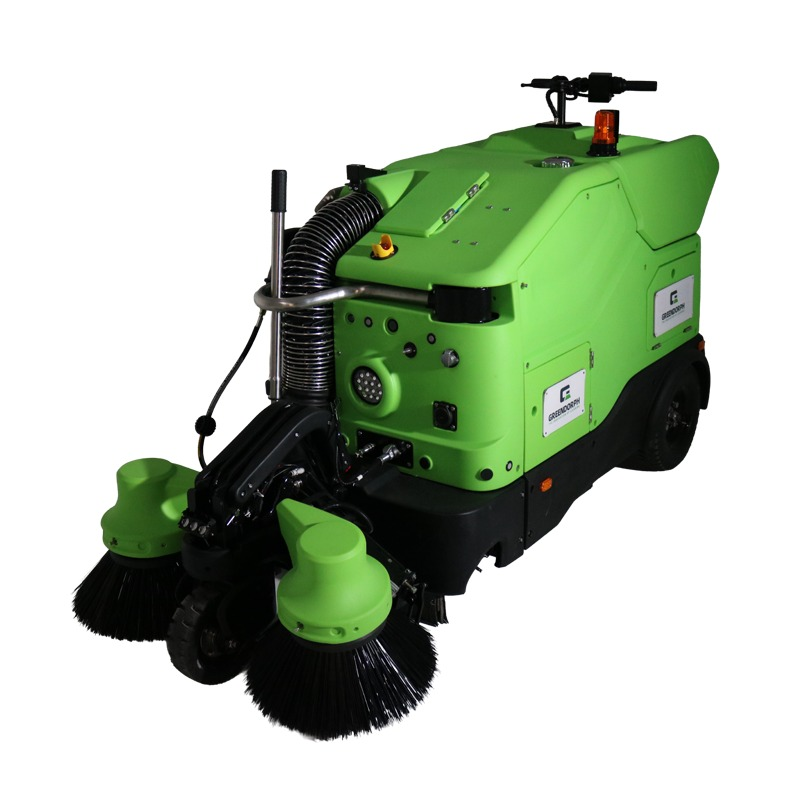
Greendorph’s parking lot sweeper includes the fully autonomous YJ130 and the flexible YJ80 family, which offers different operating modes and cleaning functions. The YJ130 has a 48V/200Ah lithium iron phosphate battery and average operating time of 6–8 hours. These details help assess operating fit, but they do not replace measured charging data or a site trial.
The YJ80 street-sweeping models are also listed with 48V/300Ah lithium iron phosphate batteries and average operating time of 6–8 hours. Functions vary by version, so check whether the selected model provides the collection, water-spray, vacuum, or washing functions required for the site. Battery size alone is not enough to rank its running cost against a fuel-based machine.
Greendorph positions its electric sweepers for outdoor settings such as parking lots, access roads, campuses, and industrial sites. Use published specifications to shortlist power sweepers for parking lots, then validate output under actual operating conditions.
Build a Decision From Site Data
Track energy or fuel use, staff hours, cleaning quality, maintenance events, and downtime over several comparable shifts. Annualize the results using the site’s expected schedule, then add purchase cost and financing where relevant. Run a conservative estimate as well as an expected-use scenario so that occasional repairs or seasonal debris do not disappear from the calculation.
Visit the official website; an electric parking lot sweeper can reduce fuel-related tasks and direct exhaust during operation, while a fuel-powered option might still suit some duty cycles or site constraints. The stronger investment is the machine with a defensible total cost per cleaned area and a service plan that keeps the site operating reliably
