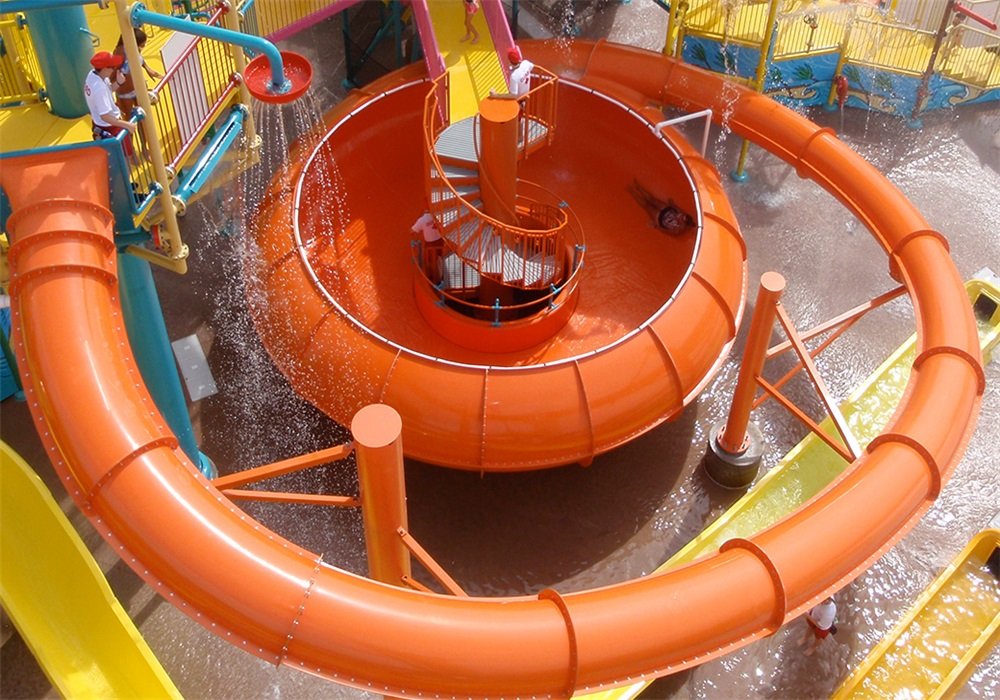
A bowl slide carries riders from a descending flume into a circular chamber, around its inner wall and towards its outlet. The defining feature of a bowl water slide is this circular stage between the initial descent and the final landing.
Among the types of water slides available to investors, that stage gives the bowl a particular identity. Its appeal centres on travelling around a shared space before leaving through the middle. The sequence explains its potential role within a venue.
Follow the Ride from Descent to Pool
Jinchao’s Super Bowl begins with riders on an inflatable raft travelling through twisting and sloping sections. This entrance leads into the circular chamber. The early descent and the bowl are connected parts of the ride, so the attraction cannot be understood from an image of the chamber alone.
Inside the bowl, the raft travels around the inner wall before moving towards the central outlet. The distinguishing moment to examine is the change from moving along a channel to travelling within a broad chamber.
The central outlet is followed by a transition section leading to a splash-pool finish. The bowl is therefore an intermediate experience within a continuous route. The equipment arrangement needs to show its exit, transition and pool.
The ride description does not establish a fixed number of circuits for every configuration. An investor can examine how the proposed entrance connects with the chamber and how its outlet leads through the transition to the splash pool.
Read the Super Bowl Dimensions Together
For this model, the starting-height range is 8–15 m. Two-person and four-person rafts are described options. The proposed bowl water slide needs an identified rider arrangement, so the shared experience can be discussed in terms of the group travelling together through the chamber.
Available flume-width options for this model are 0.8 m, 1.4 m and 2.7 m. The final arrangement requires confirmation. A water park manufacturer can specify the selected width and raft configuration together in the particular project proposal.
Approximately 300–400 riders per hour is the published capacity reference. It describes hourly throughput, whereas raft occupancy is two or four people. Keeping those figures distinct separates group size from the rate at which riders pass through the attraction.
Water-flow requirements are determined by the project design. The height range, width options and hourly figure therefore do not describe every installation detail. The specified route links those references to the chamber, transition and finish proposed for the venue.
Identify the Venue That Wants Circular Travel
The strongest reason to examine this attraction is a desire for the circular stage itself. A park with several descending routes can consider whether travelling around a chamber adds the movement it wants. Comparing types of water slides through that question gives the bowl a clearly stated purpose.
Shared participation is another relevant feature, with companions remaining on the same raft through the descent and chamber. A bowl water slide can be considered where the proposed visit includes riding together. The selected two-person or four-person arrangement determines what that shared participation means for the offered configuration.
The possible setting extends beyond a large destination park. Customised dimensions are available for hotel and pool-supporting installations as well. A water park manufacturer still needs to develop the actual route and landing arrangement around the venue rather than treating the product name as a fixed installation size.
Fibreglass colours can match the surrounding venue. That choice connects the chamber visually with its architectural setting. Colour and dimensions answer different parts of the brief: one establishes appearance, and the other places the selected attraction within the site.
Separate a Bowl from Back-and-Forth Formats
A broad curved surface does not make every raft attraction a bowl. Jinchao’s U-shaped fibreglass slide carries two riders through repeated back-and-forth travel. That reversal creates a different sequence from circling a chamber and moving towards its central outlet, even though both experiences use a raft.
Boomerang also centres on reversal: its two-rider raft climbs an opposing steep wall, slows and returns downwards before oscillating. The key distinction concerns the direction of travel through the feature. A wall-climbing sequence and circular travel need separate descriptions during an attraction comparison.
These types of water slides can be compared by following the raft through the main feature. The bowl circles, while the contrasting formats reverse direction. Naming that difference prevents a shared-raft photograph or a sweeping external curve from standing in for the actual experience being considered.
Give the Proposed Experience a Defined Configuration
Rafts are available as optional accessories with the Super Bowl package. The equipment proposal can identify whether they are included, alongside the selected rider grouping. Construction drawings, technical documentation and overseas assembly guidance are available after order confirmation, connecting the chosen attraction with its installation information.
Customising the bowl, its route and its raft arrangement gives Jinchao a specific design task for the venue. Behind that proposal is a water park manufacturer with an approximately 36,000 m² manufacturing base and an overall company record of more than 300 completed projects.
A suitable bowl proposal makes the circular experience understandable from entry to exit. Investors can then judge whether that movement belongs in their venue and develop its dimensions accordingly. The defining decision remains the journey around the chamber and onwards through the centre towards the pool.
