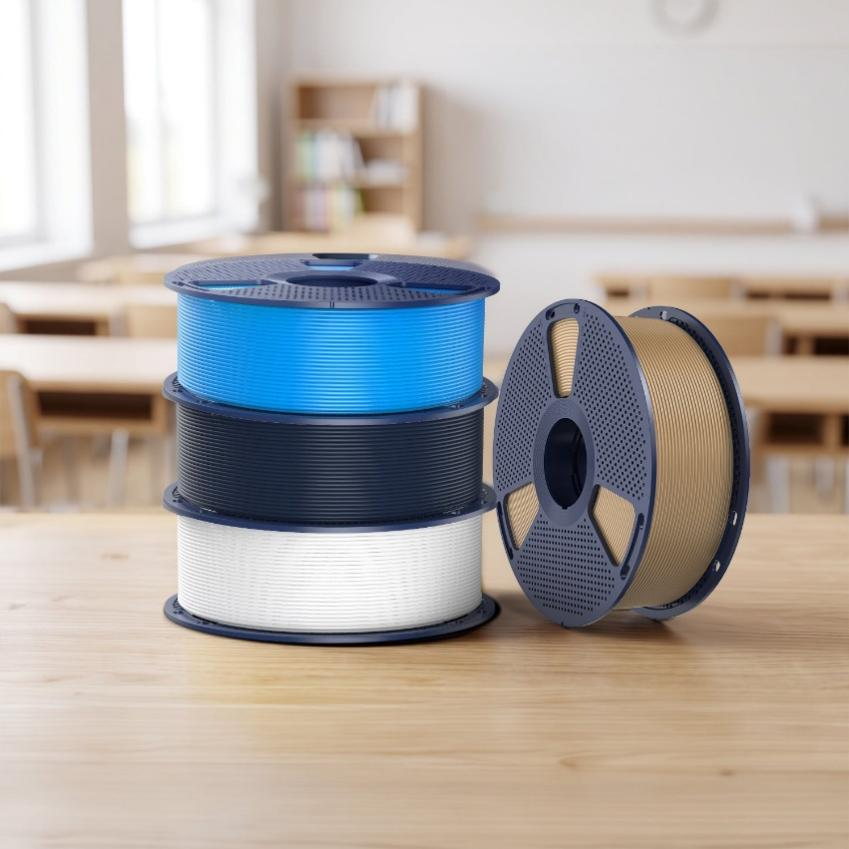
The choice between PLA+ and PLA Plus 2.0 should depend on the part being printed, the printer’s workflow, and whether the additional flow characteristics described for PLA Plus 2.0 are useful for the application. In SUNLU’s current range, both are upgraded PLA materials rather than completely different base-material categories. Their published printing ranges are also similar, so the distinction is better considered through application and workflow.
PLA Filaments: What Is Actually Different?
SUNLU lists PLA+ and PLA+ 2.0 as separate filament categories. The standard PLA+ product is described as a tougher PLA with 1.75 mm diameter and ±0.02 mm dimensional accuracy, while PLA+ 2.0 is presented as an upgraded PLA+ formulation with the same diameter tolerance. Both products are available in 1 kg spools with a stated filament length of about 330 m.
The current product pages show substantial specification overlap. Both list density of 1.21 g/cm³, Vicat softening temperature of 54°C, HDT of 56±3°C, melting point of 164°C, tensile strength of 46±5 MPa, flexural strength of 83±5 MPa, and flexural modulus of 2750±200 MPa. Their mechanical-property tables also list an IZOD impact value of 10±3 kJ/m².
Compare the published specifications rather than treating the “2.0” name as a completely different mechanical profile.
Printing Settings Are Largely Similar
For both SUNLU materials, the current product pages specify 205–215°C at 50–100 mm/s and 215–245°C at 100–200 mm/s. Bed temperature is listed at 50–60°C, drying at 50°C, and printing/storage humidity below 20% RH in a sealed container with desiccant.
| Parameter | PLA+ | PLA Plus 2.0 |
| Diameter | 1.75 ±0.02 mm | 1.75 ±0.02 mm |
| Nozzle | 205–215°C or 215–245°C | 205–215°C or 215–245°C |
| Speed | 50–100 or 100–200 mm/s | 50–100 or 100–200 mm/s |
| Bed temperature | 50–60°C | 50–60°C |
| Drying | 50°C | 50°C |
| Density | 1.21 g/cm³ | 1.21 g/cm³ |
| Tensile strength | 46±5 MPa | 46±5 MPa |
These values are starting points. Nozzle size, cooling, extrusion hardware, model geometry, and printer calibration can affect the result.
Where PLA Plus 2.0 May Matter
SUNLU describes PLA+ 2.0 as an upgraded PLA+ formulation with improved flow characteristics compared with regular PLA and support for high-speed printing up to 300 mm/s. However, the published printing ranges and several mechanical specifications overlap with those listed for standard PLA+. These specifications alone do not establish that PLA+ 2.0 will perform better in every application.
A 300 mm/s rating does not mean every printer should run at that speed. Actual throughput depends on hotend capacity, the motion system, cooling, and the slicer profile. For a meaningful comparison, test both materials on the same printer using the same model and evaluate print quality, dimensional accuracy, extrusion consistency, and mechanical performance.
When Standard PLA+ Makes Sense
PLA+ can be used when an established profile already meets the requirements and the user wants a tougher general-purpose PLA without substantially changing the workflow. Typical applications include functional prototypes, brackets, housings, fixtures, and organizers. Because the official settings overlap with PLA+ 2.0, changing between them does not automatically require a new temperature strategy. A small validation print is still useful before a long job.
For a different visual application, wood PLA should be evaluated separately. Wood-filled material is intended for a wood-like appearance rather than as a direct alternative to standard PLA+ for general functional printing. SUNLU’s Optimized Wood PLA contains 15% real wood powder and has separate printing recommendations.
When PLA Plus 2.0 Deserves Consideration
PLA+ 2.0 may be worth testing when the workflow can benefit from its stated fluidity or when higher-throughput printing is part of the requirement.
A user with a compatible high-speed printer can test it within the manufacturer’s published range and check extrusion consistency, surface finish, bridging, overhangs, and dimensional accuracy. For ordinary-speed printing, the decision may instead depend on which profile is already validated on the machine.
The PLA+ 2.0 page also describes the material as shatter-resistant and durable. These descriptions should be considered alongside the published mechanical-property table and application-specific testing.
Wood PLA Is a Separate Use Case
SUNLU’s Optimized Wood PLA contains 15% real wood powder and is intended to produce a wood-like surface appearance. Its product page provides separate temperature and speed recommendations from those listed for PLA+ and PLA+ 2.0.
For decorative models, ornaments, display pieces, or parts that will be sanded or stained, a wood grain filament may be more appropriate than either PLA+ grade. The choice should follow the required appearance and finishing process.
Storage, Food Safety, and Recycling
SUNLU recommends storing filament in a sealed container with desiccant and keeping humidity below 20% RH. Storage life and print performance depend on the material’s condition and exposure to moisture, so inspect the filament and evaluate its performance before use rather than relying on a fixed shelf-life estimate.
SUNLU cautions against using its PLA to print tableware because colorants are added during production and printed parts may also be contaminated by the printer nozzle. Do not assume that PLA or a finished 3D-printed part is suitable for food contact without verifying the material, printing process, and applicable safety requirements.
The material is recyclable, although the appropriate route depends on local collection systems and the composition of the printed item.
A Practical Selection Process
Choose standard PLA+ when its existing profile fits the part and printer. Test PLA Plus 2.0 when its stated flow characteristics are relevant to the workflow.
For users comparing PLA Filaments, the useful basis is measurable specification, printer compatibility, print settings, and the finished part’s requirements. SUNLU provides both PLA+ and PLA+ 2.0 as separate products, so users can evaluate them on the same printer and model and compare actual print results.
